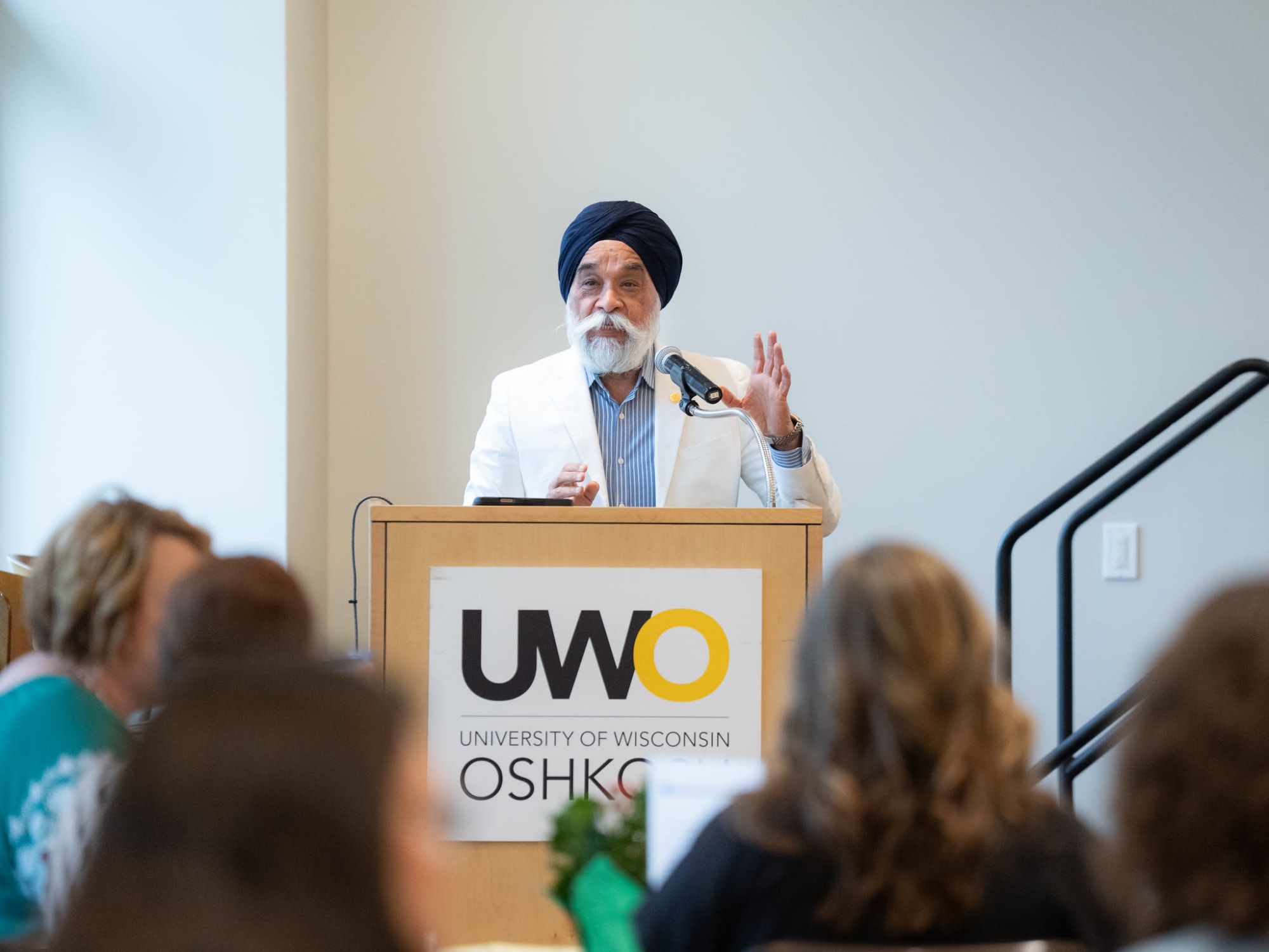
Healthcare leaders, educators, policymakers, workforce professionals and regional partners gathered Aug. 5 at the University of Wisconsin–Oshkosh for the Healthcare Forward Symposium, examining how Wisconsin can strengthen its healthcare talent pipeline while responding to rural access, workforce shortages and rapidly changing technology.
Hosted by the NEW Healthcare Alliance in partnership with UW–Oshkosh, the symposium focused on a central question: how can Wisconsin better recruit, educate, develop and retain the healthcare professionals communities need?
“Wisconsin’s healthcare workforce challenges require sustained collaboration,” UW–Oshkosh Chancellor Dr. Manohar Singh said. “Universities can connect education, research and talent development with the needs of healthcare providers, policymakers and communities.”
Growing the talent pipeline
A key theme throughout the symposium was that Wisconsin cannot solve workforce shortages simply by competing for the same employees.
Dr. Ashok Rai, president and CEO of Prevea Health and vice president of the Universities of Wisconsin Board of Regents, emphasized the need to expand the overall workforce.
“I recognize that healthcare organizations compete for patients, for contracts and—for the same people,” Rai said. “While we compete over the talent pool, we do not compete over the size of it. Recruiting from each other is zero-sum; growing the pipeline is not zero-sum.”
Dr. Seon Yoon Chung, dean of UW–Oshkosh’s Mary Novak-Jandrey College of Nursing, Health Professions and STEM, said regional partnerships are essential to creating stronger pathways into healthcare careers.
“There is real urgency in addressing Wisconsin’s healthcare workforce challenges,” Chung said. “It is critical to open talent pathways that support recruitment, retention, upskilling and career advancement across healthcare occupations.”
Those pathways extend across nursing, health professions and STEM and include both students entering healthcare careers and existing workers seeking new skills or advancement.
Technology and the workforce of the future
The symposium also examined how artificial intelligence, digital health and other technologies are reshaping healthcare delivery and workforce needs.
Matt Kures, community economic development specialist and researcher with the University of Wisconsin–Madison Division of Extension, delivered the keynote address, “Healthcare in the Digital Age.”
Kures explored how technological change intersects with healthcare delivery, regional economies and emerging workforce demands—reinforcing the need for education and training to evolve alongside the industry.
Sessions throughout the day focused on designing the healthcare workforce of the future and identifying system bottlenecks affecting recruitment, retention, career mobility and employer needs.
Rural healthcare and access
Rural healthcare emerged as another major focus, with participants examining how workforce availability directly affects access to care in communities across Wisconsin.
Marie Barry of the Rural Wisconsin Health Cooperative moderated a panel featuring Wisconsin Department of Workforce Development Secretary Amy Pechacek, Dr. Ashwani Bhatia of BayCare Clinic and Kristie McCoic of Froedtert ThedaCare Health.
The discussion highlighted the connection between workforce development and the long-term ability of rural communities to sustain healthcare access.
A regional challenge requiring regional partnership
State Sen. Kristin Dassler-Alfheim joined Singh, Rai, Patti Habeck, president and CEO of New North Inc., and other leaders in conversations spanning healthcare delivery, public policy, higher education and regional economic development.
Rebecca Deschane, vice president of talent development for New North Inc. and overseer of the NEW Healthcare Alliance, said that cross-sector approach is central to the work.
“The forum created an opportunity for healthcare leaders, educators, workforce experts and policymakers to share perspectives, explore innovative ideas and identify collaborative solutions to strengthen the region’s healthcare workforce,” Deschane said.
For UW–Oshkosh, the symposium reflects a broader role for public higher education: preparing graduates while also bringing together partners around regional challenges.
“UW–Oshkosh is ready to work alongside our partners to translate these conversations into strategic actions yielding stronger educational pathways, responsive workforce programs and expanded access to care, particularly in rural Wisconsin,” Singh said.
The symposium reinforced a shared regional priority: Wisconsin’s healthcare workforce challenge will require more than filling today’s vacancies. It will require expanding talent pipelines, strengthening career pathways, preparing workers for technological change and sustaining healthcare access in communities across the state.